In college, I learned about the Center on Media and Child Health at Children's Hospital Boston. Director Dr. Michael Rich worked as a Hollywood filmmaker before becoming a pediatrician and Harvard Medical School professor, and he brings his industry expertise to the field of medicine in innovative ways. He pioneered an intervention technique that allows children with chronic illnesses to create video narratives about their lives. The Video Intervention/Prevention project aims to help others, such as clinicians, understand the daily realities patients face. It also helps ease the transition between pediatric and adult care for kids with diseases such as cystic fibrosis and spina bifida. Check out their website for more information on their different projects!
CMCH, Children's Hospital Boston
Showing posts with label therapy. Show all posts
Showing posts with label therapy. Show all posts
Thursday, July 16, 2009


Sunday, February 22, 2009
Robotic Playmates for Children with Autism
AHN has an interesting article discussing the potential use of therapeutic robots for children with autism. Robots could prove to be an economically sound solution to addressing the needs of people with autism. Though initial research demonstrates that robots can be engaging to children with autism, it remains to be seen how robotic therapy will be generalized to interactions with other human beings.
Saturday, April 26, 2008
Case Study on VR Treatment for PTSD
Researchers at Emory University published an article on virtual reality exposure therapy for Iraq war veterans with PTSD in the most recent issue of the Journal of Traumatic Stress (view abstract here). Due to the extreme number of soldiers who experience events that put them at an increased risk for PTSD (92% of soldiers and Marines who served in Iraq report being attacked or ambushed; 70% report having seen dead or seriously wounded Americans) clinicians are trying to develop new technology to meet the mental health needs of returning veterans.
In this case study, a 29-year-old male veteran underwent four exposure therapy sessions using a VR headset system. The veteran is a combat engineer who served one year in Iraq and met the diagnostic criteria for PTSD. He reported having trouble focusing at work, driving, and sleeping. He also experienced hypervigilance - constantly being on alert - as well as mood swings and irritability.
The rationale behind exposure therapy (VR and non-VR) is based on Foa and Kozek's model of emotional processing, which posits that in order to overcome a fear, it must be activated and one must learn how to get used to it without an emotional response. Eventually, the fear can be extinguished as the patient learns to remember the traumatic incident in a non-threatening way.
During the four exposure therapy sessions, the therapist paired traditional therapeutic techniques such as breathing and treatment information with exposure in the VR environment. The system allowed the therapist to manipulate different variables that included visual, auditory, and olfactory components. As the sessions went on, the therapist increased the intensity of the stimuli to add stress. The patient completed pre-therapy and post-therapy assessments.
Although the sessions had increasing intensity, the patient's ratings on a PTSD symptoms inventory decreased as the sessions continued. By the end of the treatment, the subject's overall ratings had decreased by 56%. He initially fit the definition of "extreme" symptoms, but by the end of treatment, fell into the "mild/moderate" range of PTSD. The patient reported that he could concentrate more at work, had improved communication with his wife, and socialized more often. While this is an extremely new therapy with little empirical data, this study offers a promising vision for virtual reality researchers as well as a technical system and protocol for therapy.
In this case study, a 29-year-old male veteran underwent four exposure therapy sessions using a VR headset system. The veteran is a combat engineer who served one year in Iraq and met the diagnostic criteria for PTSD. He reported having trouble focusing at work, driving, and sleeping. He also experienced hypervigilance - constantly being on alert - as well as mood swings and irritability.
The rationale behind exposure therapy (VR and non-VR) is based on Foa and Kozek's model of emotional processing, which posits that in order to overcome a fear, it must be activated and one must learn how to get used to it without an emotional response. Eventually, the fear can be extinguished as the patient learns to remember the traumatic incident in a non-threatening way.
During the four exposure therapy sessions, the therapist paired traditional therapeutic techniques such as breathing and treatment information with exposure in the VR environment. The system allowed the therapist to manipulate different variables that included visual, auditory, and olfactory components. As the sessions went on, the therapist increased the intensity of the stimuli to add stress. The patient completed pre-therapy and post-therapy assessments.
Although the sessions had increasing intensity, the patient's ratings on a PTSD symptoms inventory decreased as the sessions continued. By the end of the treatment, the subject's overall ratings had decreased by 56%. He initially fit the definition of "extreme" symptoms, but by the end of treatment, fell into the "mild/moderate" range of PTSD. The patient reported that he could concentrate more at work, had improved communication with his wife, and socialized more often. While this is an extremely new therapy with little empirical data, this study offers a promising vision for virtual reality researchers as well as a technical system and protocol for therapy.
- Gerardi, M., Rothbaum, B.O., Ressler, K., Heekin, M., Rizzo, A. (2008). Virtual Reality Exposure Therapy Using a Virtual Iraq: Case Report. Journal of Traumatic Stress, 21, 209-213.
Sunday, April 13, 2008
Virtual Reality News April 2008
- Hunter Hoffman and David Patterson's SnowWorld, which I've written about before, is currently being used at Loyola University Hospital in Maywood, IL for burn victims. More than just a distracting media presentation, SnowWorld is an immersive VR video game that relies on the user to complete problem-solving tasks in the game, reducing their pain levels as evidenced by self-reports and MRI scans
- In stroke rehabilitation, researchers in Israel are using VR to enhance both diagnosis and therapeutic treatment selection for patients. Currently, the team of computer scientists and health professionals have designed a system that can differentiate between types of injuries - traumatic brain injuries vs. cerebrovascular accidents. Next, they will program the computers to generate models of patient recovery in order to select the best treatment for each specific patient. While diagnosis is an area that doctors can already do without the help of technology, projecting treatment outcomes with consistent accuracy is not something doctors can currently do with high consistency and accuracy. The VR is also used in patient therapy to demonstrate healthy movements of limbs without physical movement. The patient sees their limbs on a screen performing movements without pain, which can activate mirror neurons, which are frontal lobe neurons that fire when performing a task or seeing it performed. By seeing a natural movement, not experiencing pain, and having the typical motion pathway activated in your brain, pain is reduced and the patient's motility increased.
- London researchers recently used a VR headset to study paranoia in the general population, as subjects were transported via a virtual London Underground on a 4-minute ride. About 1 in 3 participants experienced paranoid thoughts about one or more of the neutral passengers populating the subway. People who experienced day-to-day thoughts of paranoia were more likely to experience it in the virtual underground. The next steps are to design a protocol that allows diagnosis and therapeutic sessions utilizing the technology. Read more here.
Citation:
Freeman D, Pugh K, Antley A, Slater M, Bebbington P, Gittins M, Dunn G, Kuipers E, Fowler D and Garety P (2008) Virtual reality study of paranoid thinking in the general population.
British Journal of Psychiatry, 192, 258-263.
British Journal of Psychiatry, 192, 258-263.
Saturday, February 16, 2008
Videos of PTSD Exposure Therapy
The Health Blog recently posted a thorough and clear explanation of how PTSD exposure therapy works, complete with video!
It also brings up an important problem that needs to be addressed before VR therapy becomes more prevalent. The article focuses on war veterans, and the studies have a high dropout rate exists because the realistic therapy is so difficult to endure. Maybe this is why (coupled with the fact it's relatively new) it's so hard to find hard numbers on VR. If you know of any, as always, please shoot me an e-mail or comment. Thanks!
It also brings up an important problem that needs to be addressed before VR therapy becomes more prevalent. The article focuses on war veterans, and the studies have a high dropout rate exists because the realistic therapy is so difficult to endure. Maybe this is why (coupled with the fact it's relatively new) it's so hard to find hard numbers on VR. If you know of any, as always, please shoot me an e-mail or comment. Thanks!
Tuesday, July 17, 2007
More on VR + CP
The idea of using virtual reality as therapy for kids with cerebral palsy isn't new. Psychologists like Dr. Denise Reid of the University of Toronto have been testing VR systems on CP patients since the early 2000s. Read abstracts here and here (subscription required for full articles). Though the sample population was small, increases were found for playfulness, upper-extremity mobility, and self-efficacy.
Helping Kids with CP Balance
CBS ran a story on VR therapy that allows children with cerebral palsy to move better by visualizing themselves in athletic environments. The system, Irex (made by Gesturetek), projects physical therapy patients onto a green-screen, participating in a variety of physical activities like skiing, soccer, and snowboarding. Each of the games or activities is designed to test a specific part or parts of the body. One group of patients who benefit from this type of therapy are children with cerebral palsy. Using this type of therapy, they can participate in engaging contact sports, which motivates them to complete their exercises, which translates to better balance and coordination.
Sunday, June 24, 2007
Wii Therapy
Patrick Stumpf of the Appleton Post-Crescent writes about the Nintendo Wii gaming system as a potential therapeutic aid because of the physical actions the system requires.
Sunday, May 27, 2007
Virtual Reality Therapy for Burn Victims
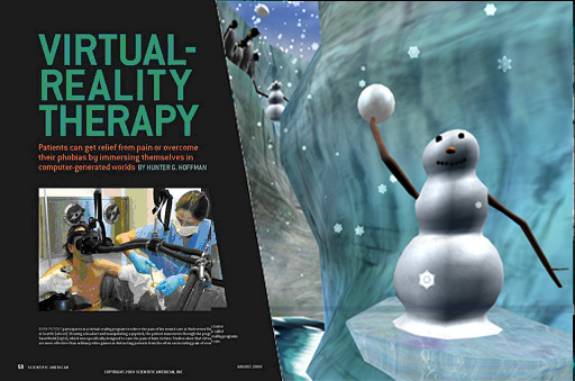
The HITLab (Human Interface Technology Lab) at the University of Washington has developed a virtual world free of potential pain triggers for burn victims. Hunter Hoffman's SnowWorld features an interactive virtual environment that offers distraction for patients as they undergo wound dressings and skin stretching.

The results of patients undergoing wound care are striking. Reported pain while experiencing SnowWorld is dramatically lower than that of patients not using VR. Moreover, in an fMRI study, healthy people volunteered to experience pain stimuli when in an fMRI machine. Some of them also experienced (magnet-friendly) virtual reality during the fMRI. The VR subjects had less pain-related brain activity than the non-VR subjects.
The lab is also working on water-friendly virtual reality gear (as you can see from the photo, they use a head-mounted display), using VR to treat Post-Traumatic Stress Disorder (a full post on that later), and VR for Spider Phobia, among various other projects.
The results of patients undergoing wound care are striking. Reported pain while experiencing SnowWorld is dramatically lower than that of patients not using VR. Moreover, in an fMRI study, healthy people volunteered to experience pain stimuli when in an fMRI machine. Some of them also experienced (magnet-friendly) virtual reality during the fMRI. The VR subjects had less pain-related brain activity than the non-VR subjects.
The lab is also working on water-friendly virtual reality gear (as you can see from the photo, they use a head-mounted display), using VR to treat Post-Traumatic Stress Disorder (a full post on that later), and VR for Spider Phobia, among various other projects.
Subscribe to:
Posts (Atom)

 Posts
Posts

